
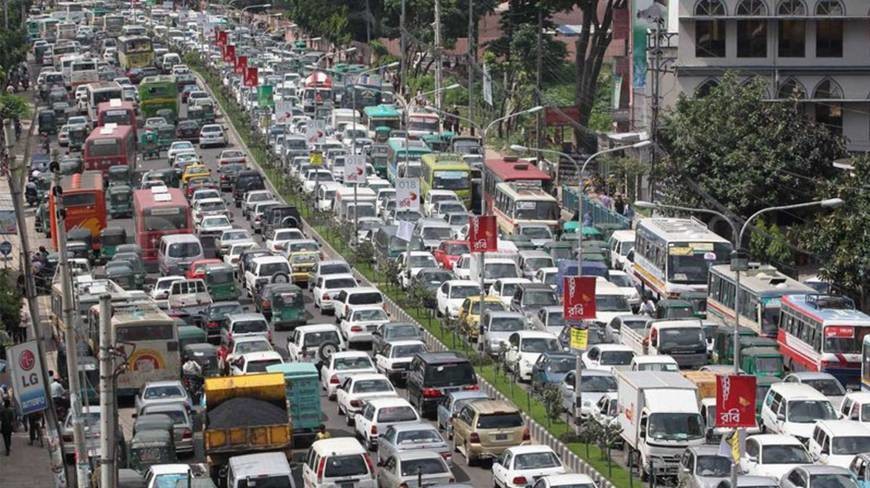
Dhaka's unbearable traffic congestion needs serious attention to prevent unwanted drain of huge national resource in the form of time, money and a very poor quality of life. Almost all the attempts so far taken to solve the traffic congestion problem could not yield expected outcomes largely due to piecemeal uncoordinated efforts targeted to treat the symptoms keeping the root causes out of scene. A system approach can help diagnose the interdependent root causes of congestion to navigate the process of developing a set of sustainable solutions. Dhaka's traffic congestion emerges from the failure of managing a hierarchical interdependent subsystems of traffic system of Dhaka where land use, business ecosystem shape infrastructure and incentives, which determine operations and enforcement, ultimately producing travel behavior that sustains congestion.
Taking Dhaka's transport as a system comprising eight interdependent subsystems can be presented in a hierarchical manner:
A clean, synthesized, non‑overlapping, hierarchical interpretation of the eight subsystems that shape Dhaka’s traffic congestion in a logically structured, systems‑engineering view of the problem organized from deep structural drivers to system enablers followed by operational subsystems resulting into behavioral outcomes.
Hierarchical model of Dhaka's eight interdependent subsystems
HIERARCHY OVERVIEW
Level 1 — Structural Foundations (determine the shape of the whole system)
1.1. Land Use & Urban Form
1.2. Business Ecosystem & Business Architecture
1.3. Governance & Institutional Framework
Level 2 — System Enablers (shape how the transport system is built and managed)
2.1. Transport Supply (Infrastructure & Network)
2.2. Economic Incentives & Pricing
Level 3 — System Operations (determine day‑to‑day functioning)
3.1. Transport Operations
3.2. Enforcement & Traffic Management
Level 4 — System Outcomes (emergent behavior)
1.1. Human Behavior & Travel Culture
This hierarchy removes overlaps and clarifies causality.
Syntheses of each subsystem are presented below with interdependencies
Level 1
1.1. Land Use & Urban Form (Structural Foundation)
Role: Determines where people live, work, and travel.
Why foundational: Travel demand originates from land-use patterns.
Key Interdependencies:
• Drives demand on transport supply.
• Influenced by business ecosystem (developers, land markets).
• Requires governance to regulate density, zoning, and growth.
Position in hierarchy:
The root of trip generation and spatial pressure.
1.2. Business Ecosystem & Business Architecture (Structural Foundation)
Role: Determines how transport services and necessary infrastructure are produced, financed, and operated.
Components:
• Bus industry structure
• Paratransit economy
• Ride-sharing platforms
• Road construction business
• Freight logistics
• Informal payments and regulatory capture
Key Interdependencies:
• Shapes transport operations (commission-based driving, competition arrangement among the operators, fragmented vs. consolidated).
• Influences transport supply (flyovers vs. sidewalks, more lanes vs. demand management).
• Affects enforcement (informal payments).
• Interacts with economic incentives (fares, pricing, revenue models).
Position in hierarchy:
The economic engine that shapes system behavior.
3. Governance & Institutional Framework (Structural Foundation)
Role: Determines who plans, regulates, and coordinates the transport system/transport market.
Key Interdependencies:
• Regulates the business ecosystem (risk and revenue sharing mechanism among parties involved in transport service delivery).
• Determines investment in transport supply.
• Sets economic incentives and disincentives to promote good behavior of all the stakeholders of the system (taxes, pricing, subsidies).
• Controls enforcement and traffic management.
Position in hierarchy:
The institutional backbone that shapes all other subsystems.
Level 2
4. Transport Supply (System Enabler)
Role: Physical capacity and network structure.
Components:
• Road network
• MRT/BRT
• Footpaths, cycling lanes
• Intersections
• Ring roads, bypasses
Key Interdependencies:
• Determined by governance and business ecosystem.
• Influences operations (bus behavior, bottlenecks).
• Shapes human behavior (mode choice).
Position in hierarchy:
The hardware of the system.
5. Economic Incentives & Pricing (System Enabler)
Role: Determines the cost of travel and the financial logic of operators.
Components:
• Parking pricing
• Fuel pricing
• Bus fare structure
• Congestion pricing (absent)
• Incentives for quality service
Key Interdependencies:
• Shapes business ecosystem profitability.
• Influences human behavior (car vs. bus).
• Affects operations (competition, route choices).
Position in hierarchy:
The economic logic that drives choices.
Level 3
6. Transport Operations (System Operation)
Role: Day-to-day functioning of the transport system.
Components:
• Bus driving behavior
• Route rationalization
• Paratransit movement
• Freight movement
• Ride-sharing operations
Key Interdependencies:
• Driven by business models (commission-based driving).
• Constrained by transport supply (narrow roads).
• Affected by enforcement (illegal stops).
Position in hierarchy:
The software of the system.
7. Enforcement & Traffic Management (System Operation)
Role: Ensures compliance and manages flow.
Components:
• Traffic police
• Signal timing
• Illegal parking control
• Roadside friction management
• Real-time monitoring
Key Interdependencies:
• Influenced by governance and business ecosystem.
• Directly affects operations (lane discipline, bottlenecks).
• Shapes human behavior (risk-taking).
Position in hierarchy:
The control system of the network.
Level 4
8. Human Behavior & Travel Culture (System Outcome)
Role: Emergent behavior resulting from all upstream subsystems.
Components:
• Mode choice
• Risk-taking
• Preference for door-to-door travel
• Trust in public transport
• Compliance with rules
Key Interdependencies:
• Shaped by service quality (operations).
• Influenced by pricing (economic incentives).
• Constrained by infrastructure (supply).
• Conditioned by enforcement.
Position in hierarchy:
The final emergent outcome of the entire system.
Logical interpretation of interdependencies
1. Structural Foundations → shape → System Enablers
Land use, business ecosystem, and governance determine what infrastructure is built for whom and what incentives exist.
2. System Enablers → shape → System Operations
Infrastructure and pricing determine how buses, rickshaws, cars, freight and transport operators behave.
3. System Operations → shape → Human Behavior
Daily experience determines whether people trust public transport, choose cars, or break rules.
4. Human Behavior → feeds back into → Structural Foundations
High car ownership → political pressure → more flyovers → reinforcing the cycle.
This is a complex adaptive system with feedback loops, not a linear chain.